in collaboration with Raymond Warnerin, Frans Tamasoleng, Susanty Artha Gilberte
2017, JASINDO HEADQUARTERS DESIGN COMPETITION, JAKARTA
White Tenun Tower
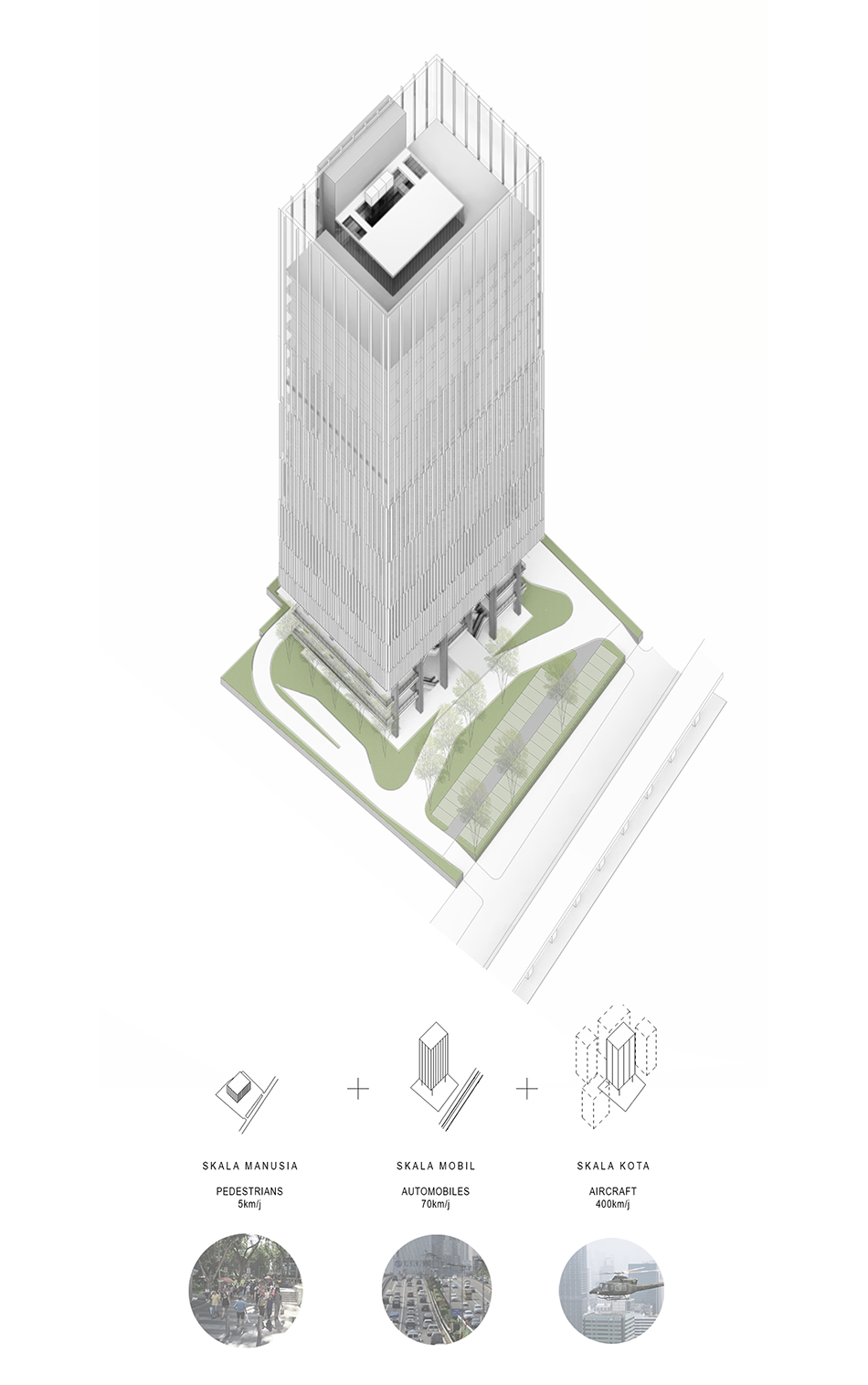
A tall building should interrelate between the human scale and the scale of the surrounding buildings in the city. With the location of the site between the pedestrian lane, street, overpass freeway and the light rail transit the relationship of buildings with other scales are amplified due to differences in speed of movement and perspective.
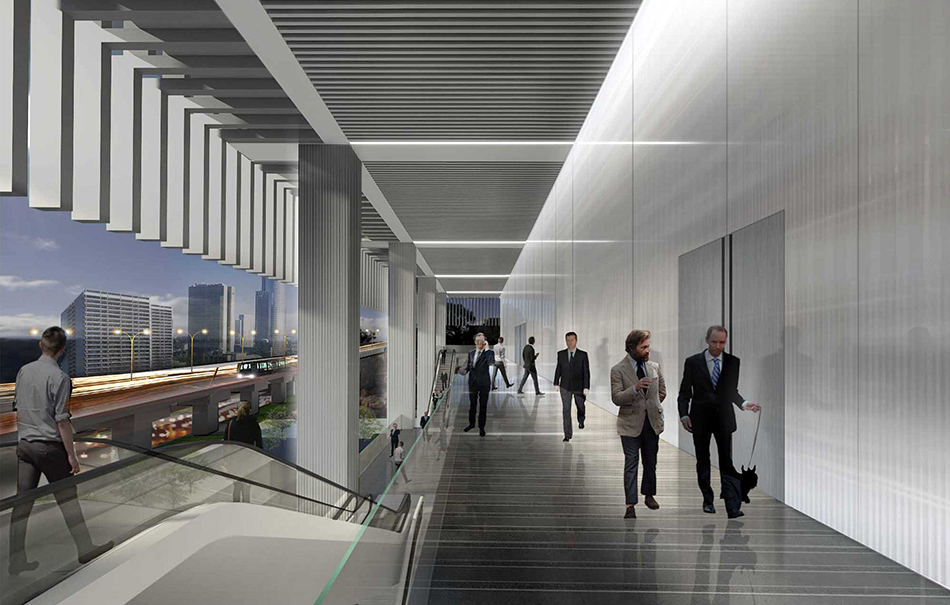
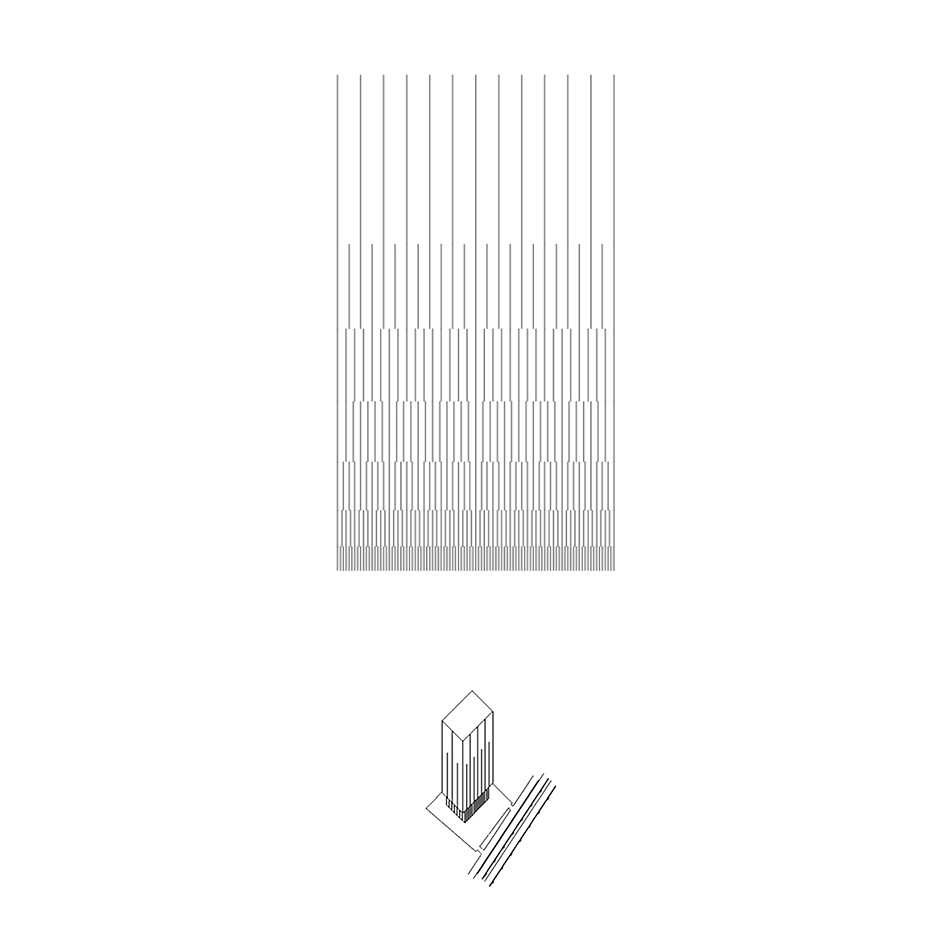
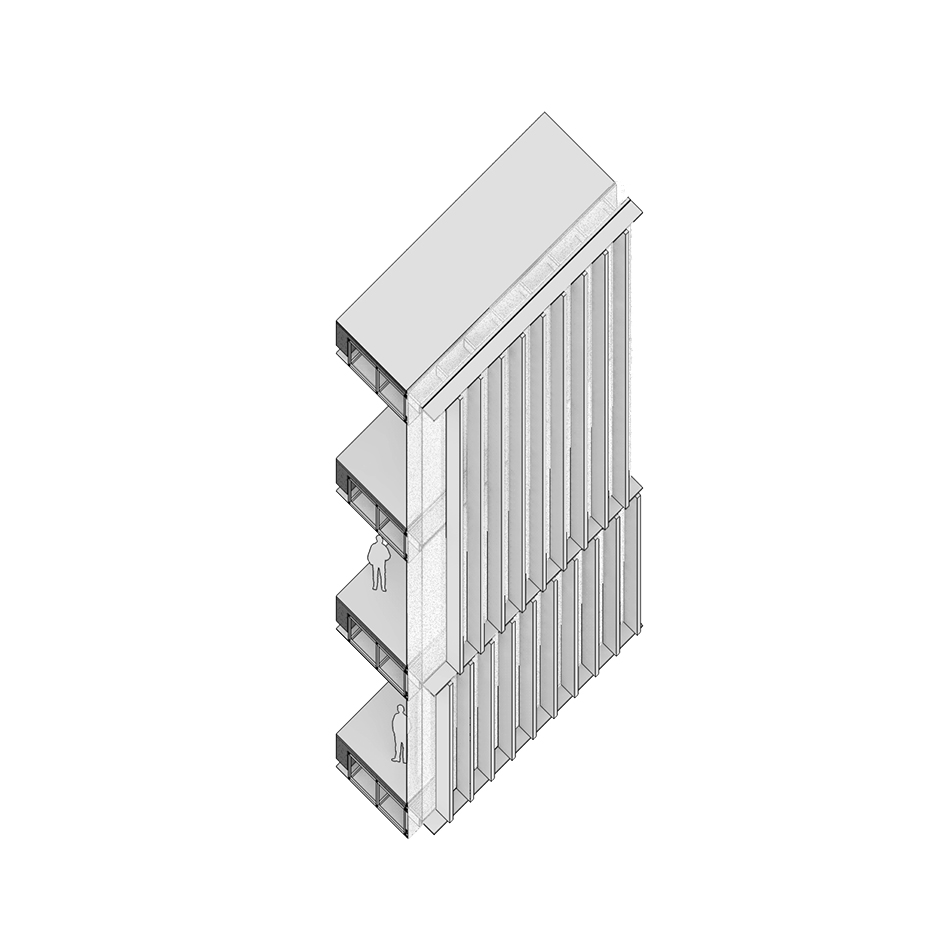
The four storey podium is a direct formal response to the overpass whilst the office tower is sitting above. The podium consists of public facilities featuring open mezzanine levels with a view to the surroundings. Vertical fins is a logical sunscreen solution, graded in scale and exaggerates height, is arranged from human scale, scale of vehicular perspective, scale of buildings and finally the scale of the cityscape are weaved (tenun in Indonesian) in a continuous manner. The result, a unique facade expression that is experienced differently depending on the mode of movement.
Energy systems strive to promote optimum natural systems wherever possible, including an innovative employing mist in the double skin glazing system from collected rainwater to cool down the building, natural ventilation in the lobby, mezzanine and atrium, and greywater recycling.
The atrium within the building penetrates from the ground level to the uppermost level, functioning not just as a ventilation strategy, but also allows visitors from the lobby to have a glimpse to the sky. The open air four level mezzanine acts as a circulation space for the public facilities, and also exhibits the public activities to the street, humanising the scale of the tower. The facade articulation returns into the soffit of the podium, creating a grand ceiling to the public towards the auditorium.
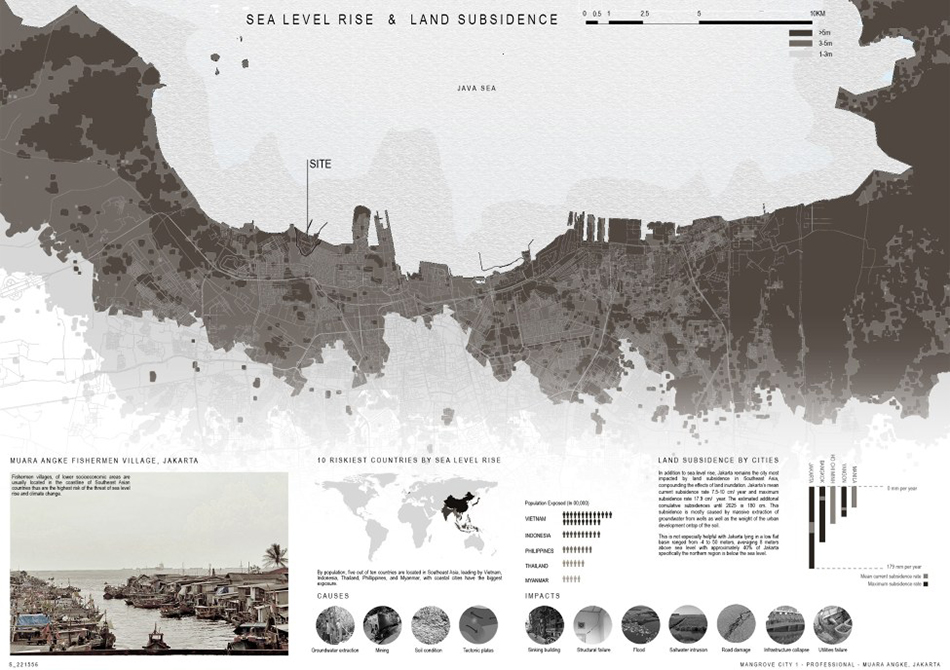
Our architectural proposal to the current and foreseeable issues of sea level rise and land subsistence is not one of defence strategies such as sea wall or land filling that requires continuous effort but rather working in tandem with the nature. Mangrove will be planted to stabilise the soil and improve sedimentation whereas the floating platform will be built around mangrove trees – that rises and ebbs according to the sea level.
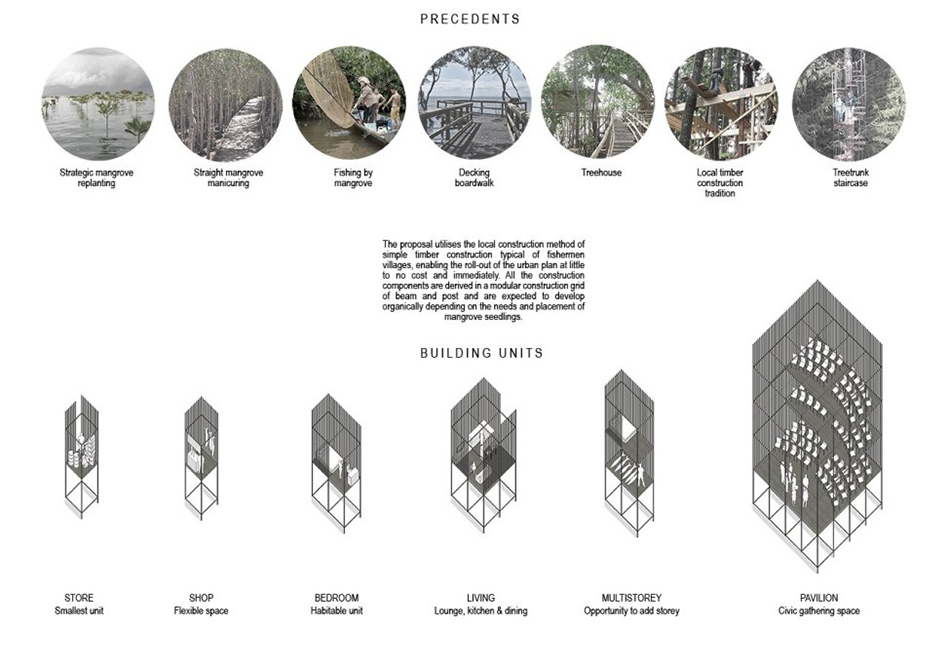
Starting with a single mangrove tree, a floating platform is constructed around it, using the tree as an anchor and support. This platform can then be used for landing of boats, and for fishing, hanging nets from the platform. As the tree grows, the tree can be pruned to grow straight up. Steps can then be constructed and a second platform can then be built to form the second level. This platform will then be connected to other platforms via a broadwalk spanning across the mangrove forest, creating a new layer above the water.
The proposal utilises the local construction method of simple timber construction typical of fishermen villages, enabling the roll-out of the urban plan at little to no cost and immediately. All the construction components are derived in a modular construction grid of beam and post and are expected to develop organically depending on the needs and placement of mangrove seedlings.
Four main ingredients are proposed for the urban design strategy; the mangrove floating hub, building units, pavilions and boardwalk decking each playing their own role. Taking upon the Indonesian urban typology of a fishing village and the cooperative ‘gotong-royong’ the mangrove hub and the pavilions acts as urban centers for the community. The elevated boardwalk serves as the primary pedestrian level whereas the canals and sea level acts as landing and movement of boats.
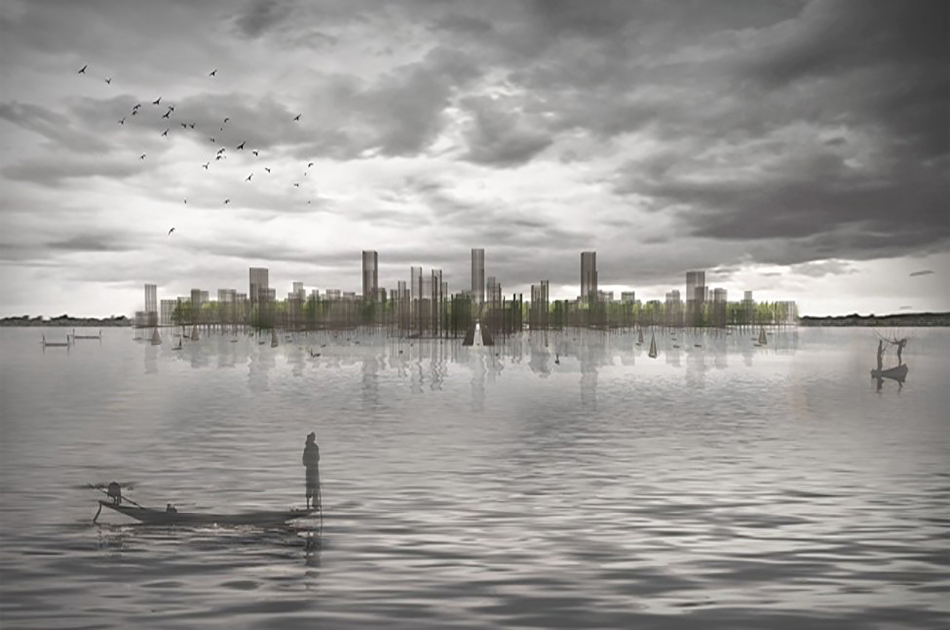
The pavilions looming over as urban centers of the organically developed city provided by the modular framework, and local timber construction engrained within fishermen villages. Mangrove tree courtyards provide relief to otherwise heavily dense settlement sitting harmoniously within the city. Overarching canals and boardwalk act as fingers towards the ocean, guiding the replanting of mangroves hand in hand with the continual sustainable development of the city that is always under construction.
The urban strategy roadmap outlines the future development from a fishing village into a Mangrove City into a fully fledged self-sustainable economic city in fifty years timeframe. The main areas of focus would be fishing industry, mangrove reforesting and sea level climate research to be developed into an international hub with both development and environment improved hand in hand as opposed to against each other.
The urban architecture proposal of employing the mangrove tree in conjunction with the floating decking platform tackling both the threats of sea level rise and land subsidence at both fronts in a symbiotic manner instead of a defensive nature. The architectural form and construction embosses the culture and tradition of that of a Southeast Asian fishing villages, restoring honour and pride to that of the honest fishermen’s work while the urban strategy roadmap progressively advances the local economy of the fishing industry and mangrove ecology into the future of a internationally recognized fishing hub and sea level & climate change response headquarters.
2015, SUBMISSION FOR TAPESTRY DESIGN PRIZE FOR ARCHITECTS
Proposed for the 2015 Australian Pavilion at the 56th Venice Biennale, this piece of tapestry is a figurative collage of major Australian skylines and landscape. Like New York City’s diorama at the 1939 – 1940 World’s Fair, a large wall tapestry envelops a grandroom, extending observer’s perception to that of the image. Unlike a picture window, the image do not have to simulate a reality that we know, but rather offers a visual interpretation.
Similar to an actual woven tapestry, the collage is a carefully joining of patchworks that defines a whole. As a nation cannot be adequately defined by the skyline of a city, this piece collages skylines of the major Australian cities; namely Sydney, Melbourne, Brisbane, Perth, Adelaide, Gold Coast as well as Hobart, Darwin and Cairns. The word ‘skyline’ is a rather oxymoron when compared to the predominantly flat landscape of Australia. The image here then reflects the central flat plains of Australia, with the foreground dominated by major Australian coastal cities. Canberra, the Australian capital, designed by Walter Burley Griffin and planned between the two largest cities of Sydney and Melbourne is an etching into the inland Australian landscape. While a typical image of a city’s skyline focuses on a tall well-known skyscraper, this collage fixates itself into the natural rock formation of Uluru / Ayer’s Rock – an affirmation that natural landscape defines Australia as much as the skyline of cities.
in collaboration with Philip Stejskal and Christopher Pratt 2014, GEN-Y LANDCORP DWELLING COMPETITION
Our proposal looks at the possibility of ‘infiltration’ as a means of making available good design and basic amenity to a large number and range of people who cannot typically afford a custom-designed home. Architects have for a long time been trying to make the individual, custom-designed home affordable, however, have been unable to compete with the mass housing (project home) market, which operates on repetition and volume. Sadly this market delivers generic homes that are gravely deficient in terms of fundamental amenities (which we believe are ‘basic rights’ that persist regardless of generation), and in their response to place and the individual occupant.
We believe there is a viable hybrid.
Our proposal suggests that a relationship may be possible between architect and the project home sector, which allows the above deficiencies to be remedied in a way that is ‘low-impact’ on the existing delivery methodology of the project home-a method which is inherent to its affordability (repetition and volume). Such low-impact infiltration is premised on a deep knowledge of this delivery process and typical construction details, structural member spacings, sequencing, etc. to ensure that any intervention minimises disruption to “business as usual”. The aim is to ‘slip’ good design into an existing framework almost unnoticed and thereby continue to reap the affordability benefit of mass-production whilst providing fixes to some fundamental deficiencies such as access to north light, cross ventilation, views of the sky, etc. The affordability of these interventions themselves lies in their proposed universality. We do not foresee individually designed interventions, rather a scalable solution that is designed once and applied in volume. The proposed universality is made possible by the consistency of the ‘host’ dwelling -the project home -which relies on the repetition of identical details, identical processes, identical materials, from one home to the next in order to offer affordability.
The proposed interventions are therefore envisaged as ‘plug-ins’ that are selected by the client in response to a particular need, at one of the available scales (which have been derived from relevant construction modules in the host dwelling, eg: rafter bays, joist bays, etc), and are installed according to illustrated instructions that cater to the limited variables that exist in a project home (eg: varying substrates, roof pitches, etc). The plug-ins are pre-wired (builder provides an additional circuit and a junction box), pre-insulated, pre-rated for energy efficiency and fire separation (if required). Plug-ins allow members of the Gen Y public to individuate their base project home (or established dwelling) by engaging in a familiar process that speaks to their expectation of (quality) choices and their pursuit of individuality.
The immediacy of goods and information via the smart phone allows an arising need to be met promptly. GenY no longer needs to plan ahead. The expectation is that a solution will be accessible as the need arises. However, the project home does not offer this flexibility. It asks them to anticipate all future needs and make a selection on this basis. A contract is then signed, and a home built. Our hybrid typology seeks to compensate for this inflexibility by overlaying the linear process offered by the project home market with a more familiar procurement pattern according to the following possible scenario:
The GenYer finds a project home (or existing home) that addresses as many needs as possible and as currently identified. The home is affordable and offers maximum space for money. It is acknowledged that it doesn’t tick all the boxes. The Gen Yer has an understanding of good design and wants access to it, but cannot afford a custom designed home. Our proposition: the deficiencies of the base project home are remedied individually by a series of ‘plug-ins’. Their cost is minimised on the same basis as the project home. It is further offset by deletion of ‘feature’ elements (eg: faux stone facade) that are of no value to the GenY client. The home is initially built with a series of plug-ins, then retro-fitted with others as needs arise. These plug-ins give the Gen Yer access to architecture affordably to address their expectation of good design. These components intervene on their host dwelling to remedy its deficiencies and individuate. Finally, they address the GenYer’s expectation that needs can be gratified as they arise: plug-ins can be retro-fitted easily as they are designed inherently to respond to the standard construction techniques, dimensions and practices of the local mass housing industry.
The proposed dwelling typology by its nature easily addresses varied living requirements/ occupancy configurations. Whether accommodation is required for a family comprising 2 adults+ 2 children, 2 couples or 4 individual adults, the methodology of individuating/ tailoring an affordable base with needs-specific plug-ins, is inherently versatile. The inaugural range of plug-ins will focus on basic amenities. They will include a ‘north-light’ plug-in, a ‘cross-ventilation’ plug-in, ‘green roof’ and ‘stepped roof terrace’ plug-ins designed to reclaim basic amenities that are typically ill-addressed in the project home. By nature of their design these plug-ins will bring delight to the otherwise generic environment of its host, with a focus on occupant well-being.
The sustainability of our proposal is rooted in the fundamental transformation of the host project home from a climatically and socially unresponsive building into one that reclaims the basic amenities through innovative plug-in designs. Its sustainability is further cemented when considering the relevance of this typology to existing homes with fundamental deficiencies. Rather than being demolished, they are retro-fitted with plug-in remedies. However, the ultimate sustainability of our proposal lies in its parasitic nature. We are not offering a dramatic sustainability or proposing a paradigm shift. Rather, the success of our proposal relies on a quiet transformation of the existing (and upcoming) housing stock by infiltrating the status quo.
Finally, the proposed methodology allows the resultant hybrid dwelling to enjoy greater connectivity with its context by augmenting its environmental and social relevance by way of appropriate plug-ins. The generic project home is anchored to its ‘place’ through an architecture of specific manoeuvres.
2014, SUBMISSION FOR CANTERBURY EARTHQUAKE MEMORIAL COMPETITION
The quake unforeseen.
A reminder, mother nature’s fury.
The earth is to be respected, the ground sacred.
Following the groundline –
The plates, the plateaus emerge from the terrain.
Amongst low wall seats, the serene lawn.
Ramps carving slightly into the earth.
Steps terracing the ground.
Descending slowly into the river.
Water ebbs and flows against the plates.
Touching the water, a reflection. A contemplation.
The plateau, memorial ground. Local stone, Waitaha pavers.
Gold etched into the stone, 185 names.
To the earth, we remember.
proposal for pop-up bookshop design in corrugated steel
SUBMISSION FOR ARCHITEXT POP-UP BOOKSHOP DESIGN AT THE NATIONAL ARCHITECTURE CONFERENCE
2014, PERTH CONFERENCE CENTER
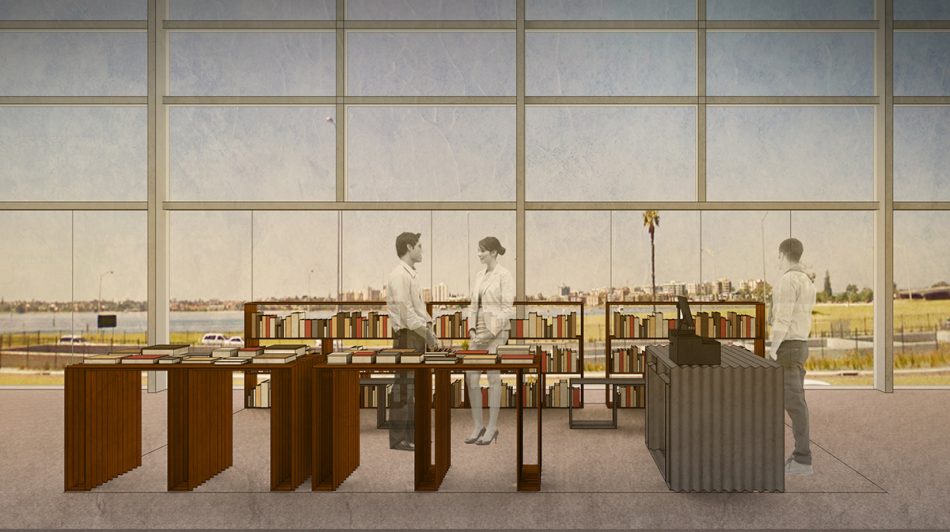
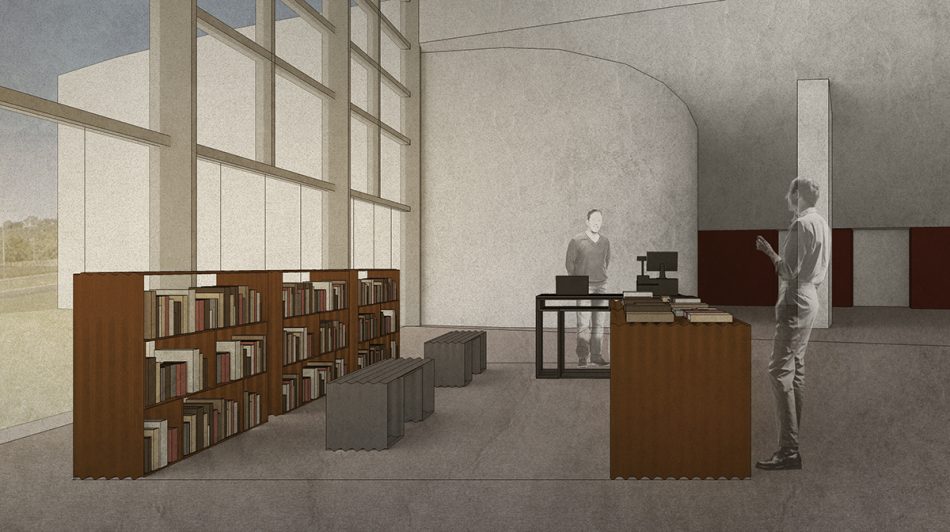
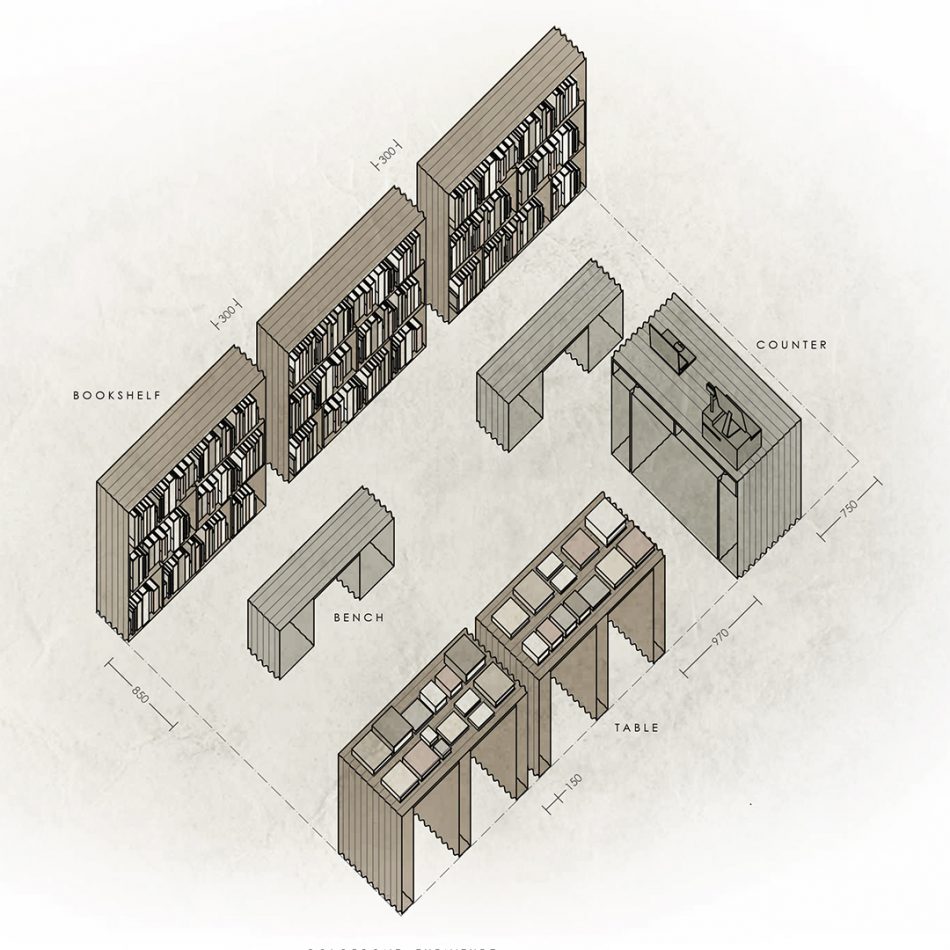
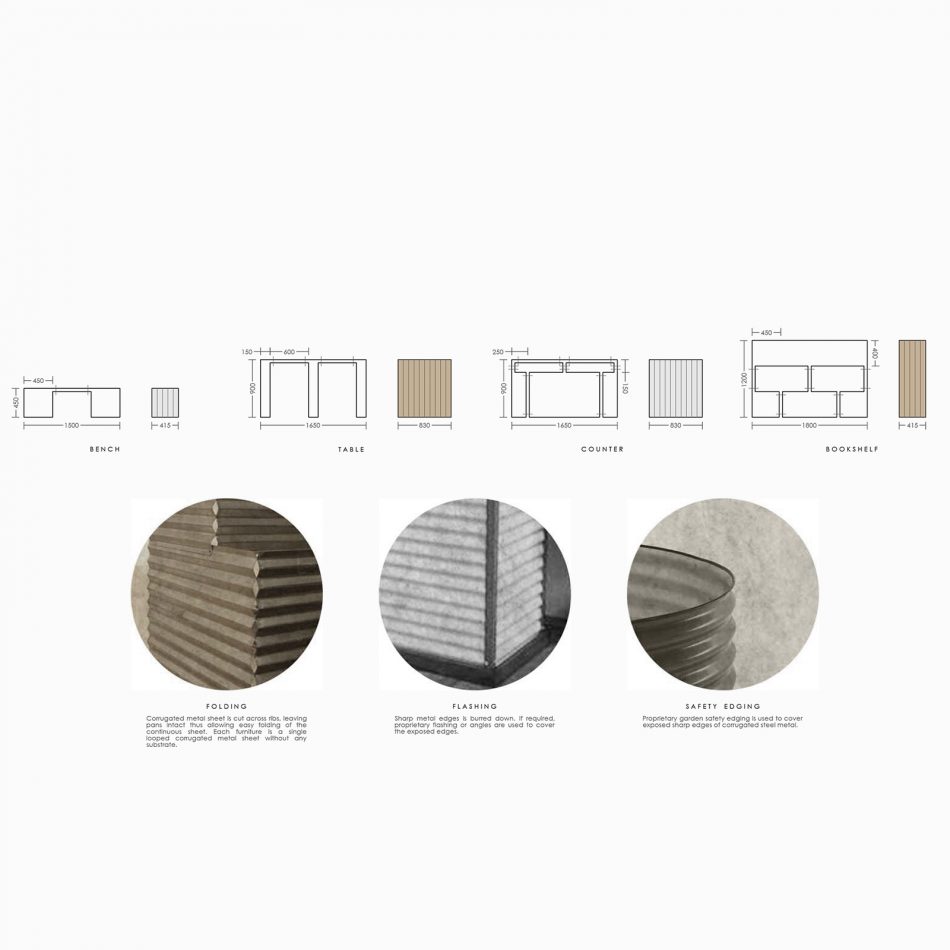
A single sheet of paper if folded correctly can support a brick. This is the initial idea of the work, where corrugated metal sheet are folded upon itself to give itself structural integrity to support weight. A single sheet of corrugated metal is cut across the ribs, leaving the pans intact thus enables the folding of the continuous sheet. The metal sheet is then folded into a looped shape that stands on its own without any other structural support apart from some stiffeners. Sharp edges are either buffed, flashed or covered with proprietary tools or products.
table; steel parallel flange channel and meranti solid wood
MEJA
SUBMISSION FOR RIVA 1920
2014
Marriage of wood and steel.
Meranti dan keluli.
Solidity and rigidity.
Expressing the structural aesthetic of the industrial steel parallel flange channel (PFC),
75 x 40mm welded support posts and beam.
Table top features 45mm meranti solid wood spanning 2.4 meters long.
SUBMISSION FOR 1 x ∞ IDEAS COMPETITION
2013, HAYNIE’S CORNER, INDIANA, USA
Momentful urban space to anchor artworks for the art district in Haynie’s Corner. Bringing people up around the oculus to an elevated balcony for activation.
Top 7 entry
PINarchitecture Competition
2013, PERTH
‘”The low anchored cloud would be a brilliant relief from the heat for a city’s residents and ecosystems alike. Additionally, one can imagine the comfort and allure of the mist as a catalyst in activating public space at-will.”
Submission for the brief of The Sweating City; global temperatures are rising, on average, and will continue to rise for the foreseeable future. Air conditioning and shading devices may not be enough to sustain the livability of cities, where the majority of the world’s population now lives. Sweating is an automatic mechanism to regulate body temperature. Similarly, how might a city regulate its temperature through an automatic water distribution system? Where will water come from, with increasing need and diminishing sources? How might the volume of water needed during heat events be delivered through a network, or series, of devices? How might a city sweat?
Delirious City Beach: A Sarcastical Manifesto for Roachattan
in collaboration with Andrei Smolik, Amy Quach, Jessie Nguyen & Lee Ren Jian
MERGE SANDCASTLE BUILDING COMPETITION
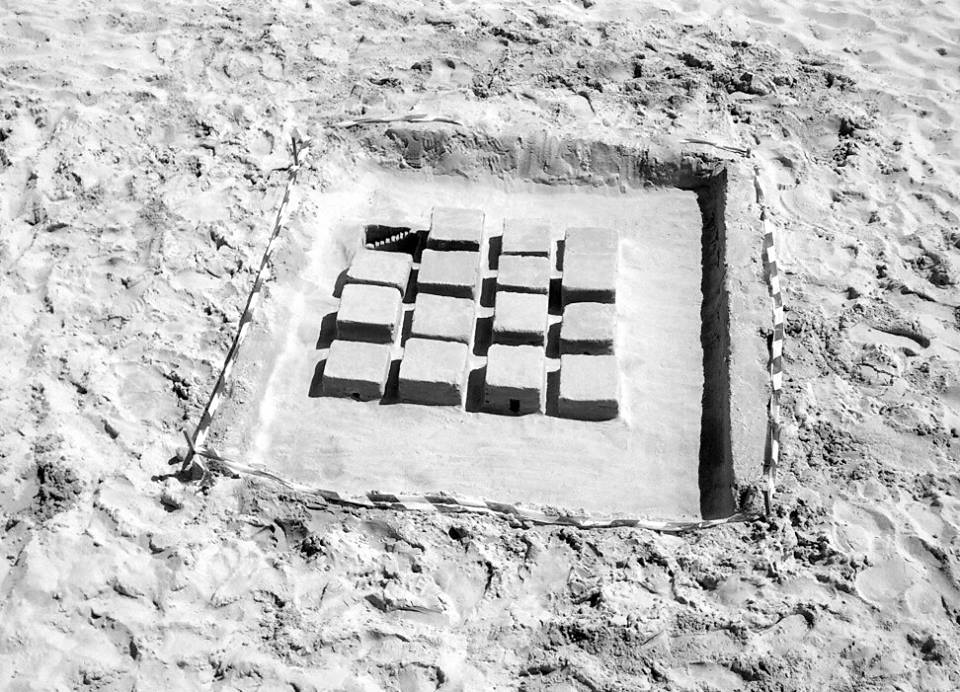
The sandcastle competition brief calls for the imagining of sandcastles as habitat for cockroaches. Peter Eisenman’s Monument to the Murdered Jews of Europe, New York Manhattan’s city grid and Le Corbusier’s Ville Contemporaine for Paris all serves as backdrop to the urban manifesto to the insect species, that is doomed to fail, thanks to the chaotic and erratic nature of the cockroach in contrast to the imposed order and strict cleanliness of the city. It will however serve as a failed example of the parallel modernist experiment for the fellow cockroaches.